About the Author: Dolce Music Institute Editorial Team

The desire to learn an instrument often begins quietly in the back of the mind.
Perhaps you have been thinking about it for a long time, or perhaps the idea has only just come to you.
Many adults then begin to wonder whether they really have enough time.
The good news is that you do not need to clear your entire afternoon every day.
It is not the length of time that matters, but the regularity.
Even short, focused practice sessions can make a real difference.
What matters most is that you keep going and feel comfortable with the process.
Music should not become an additional source of stress.
It should enrich your life.

How Much Should You Really Practise as a Beginner?
At the beginning, consistency matters most.
For beginners, 15 to 20 minutes of daily practice is best.
This amount of time feels manageable and can be integrated easily into everyday life.
At the same time, it is long enough for you to feel that you are making progress.
Your brain processes new movements more effectively in small, regular sessions.
Longer gaps between practice sessions, by contrast, tend to slow down the learning process.
With short practice sessions, you build a stable routine.
This routine gives you a sense of security and helps your instrument feel increasingly familiar.
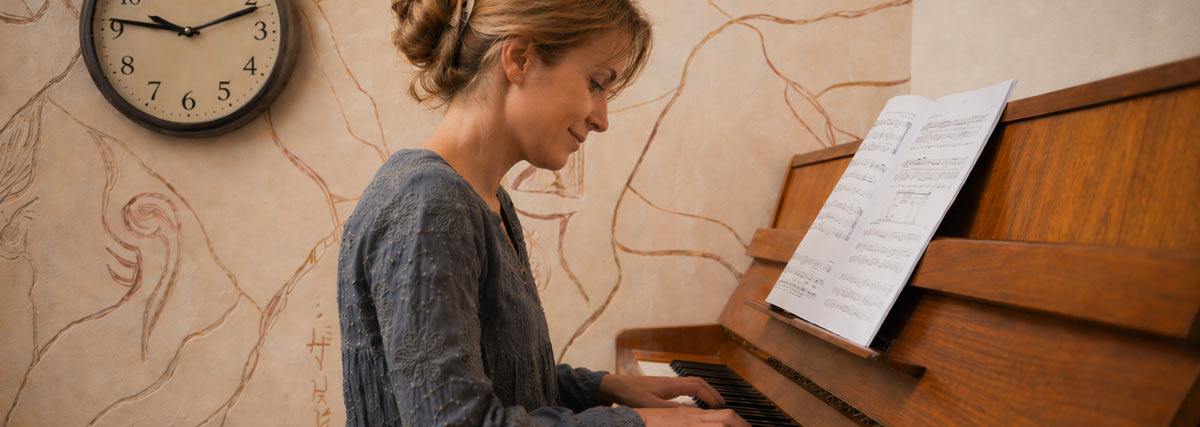
Are Long Practice Sessions Really More Effective?
Many people believe that practising for several hours at a time will get them to their goal more quickly.
In practice, the opposite is often true.
After a certain point, concentration begins to fade and mistakes start to creep in.
In addition, motivation often begins to decline.
Regular, shorter practice sessions are far more effective in the long term.
You stay focused and work more precisely.
Your body learns movements accurately, and your ear develops step by step.
Instead of one long day of practice each week, several shorter sessions are far more effective.
This creates a continuous connection with your instrument.
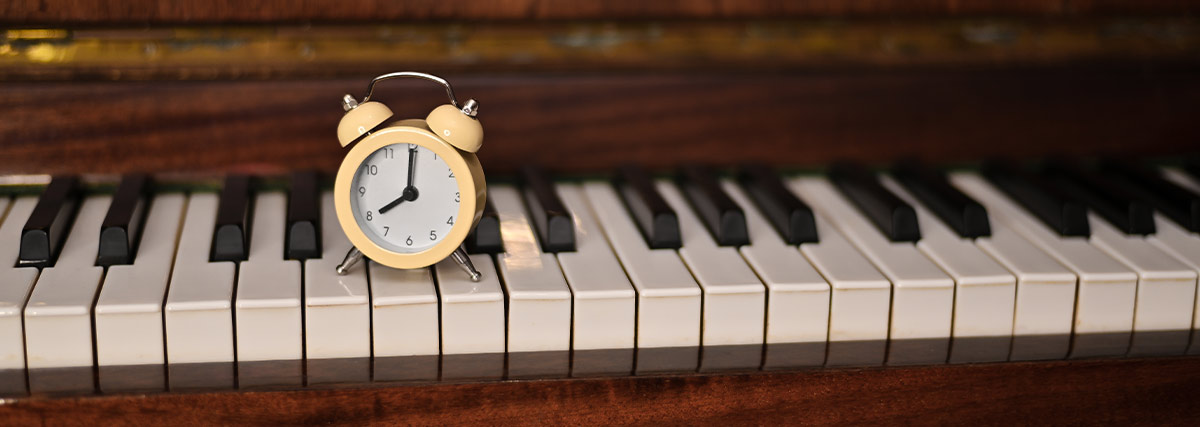
Small Sessions, Big Results
Short practice sessions are easier to fit into your daily routine.
They feel less demanding.
At the same time, they help to build a stable habit.
As a result, your progress becomes more consistent.
Your motivation is also more likely to stay strong
To make your practice time especially effective, these simple principles can help you:
- always begin with a short warm-up
- work towards one clear, small goal in each session
- repeat difficult passages slowly and mindfully
- end each session with something you enjoy
- keep a few brief notes on your progress
This structure brings a sense of calm to your learning process.
You always know what to do.
That gives you confidence. At the same time, it leaves enough room for enjoyment.
It is precisely this combination that helps you stay committed in the long term.
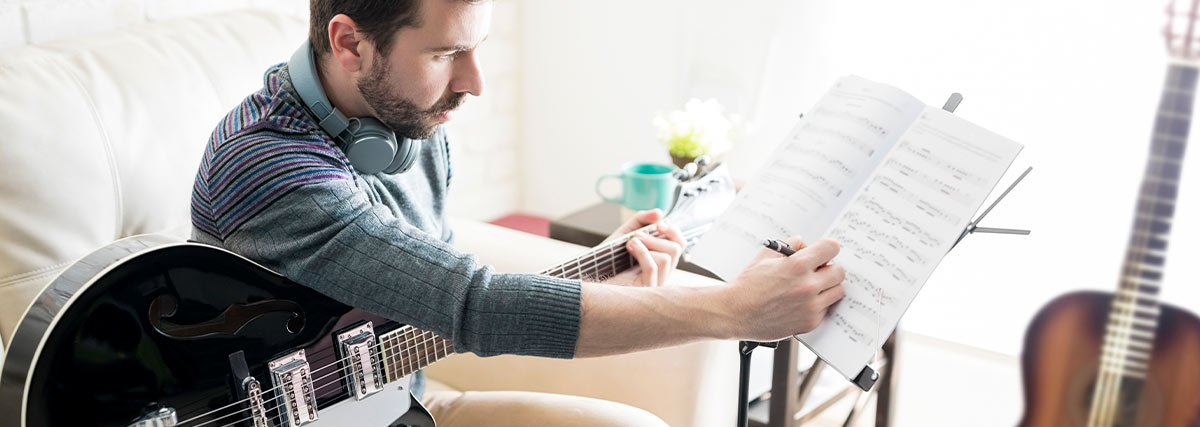
Why Is Musical Education So Important for Your Motivation?
Practising without understanding often feels tiring.
You play the notes, but do not recognise how they relate to one another.
This is exactly where well-founded teaching makes all the difference.
Music theory and practical guidance give you a clear sense of direction.
You begin to understand why something works, and that can increase your motivation significantly.
You are no longer practising blindly, but with clear purpose.
Progress becomes visible, and mistakes are easier to understand and correct.
Learning becomes clearer and more structured.
Your enjoyment of playing also grows, because you experience music not only on a technical level, but also emotionally and consciously.

How Does the Dolce Music Institute Support You in Practical Terms?
The Dolce Music Institute supports adults in a focused and individualised way.
Here, your personal goals are at the centre of everything.
You are given a clear structure for your practice.
There is also room for your own interests.
Your teacher will develop a practice plan that suits you.
It is shaped around your daily routine.
This creates a realistic routine rather than a sense of pressure.
You also benefit from continuous feedback.
This helps you overcome uncertainties more quickly.
You feel supported throughout the process.
And that is exactly what strengthens your confidence in your own learning process.
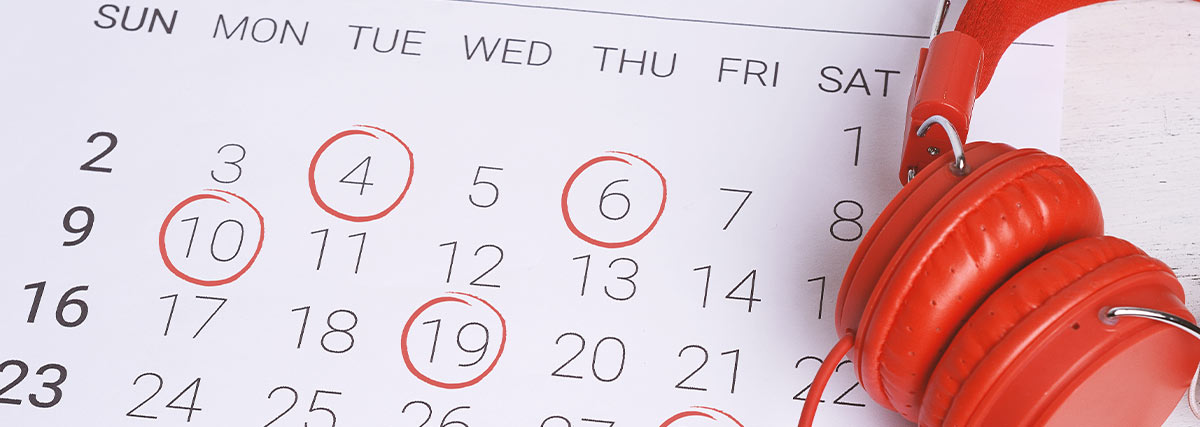
Your Personal Practice Plan at a Glance
A clear plan gives you direction.
It saves time and energy, and you know exactly what matters most.
The following overview shows what a well-structured week might look like:
| Day | Session Focus | Duration | Goal |
|---|---|---|---|
| Monday | Technique and Fundamentals | 15 to 20 minutes | develop accurate movement patterns |
| Tuesday | Review | 15 to 20 minutes | build confidence |
| Wednesday | new material | 15 to 20 minutes | make progress |
| Thursday | rhythm and timing | 15 to 20 minutes | improve stability |
| Friday | Favourite Piece | 15 to 20 minutes | strengthen motivation |
| Saturday | free playing | 15 to 20 minutes | develop creativity |
| Sunday | light review | 10 to 20 minutes | stay relaxed |
This plan can be adapted flexibly.
It serves as a guide rather than an obligation.
What matters most is that you find your own rhythm.
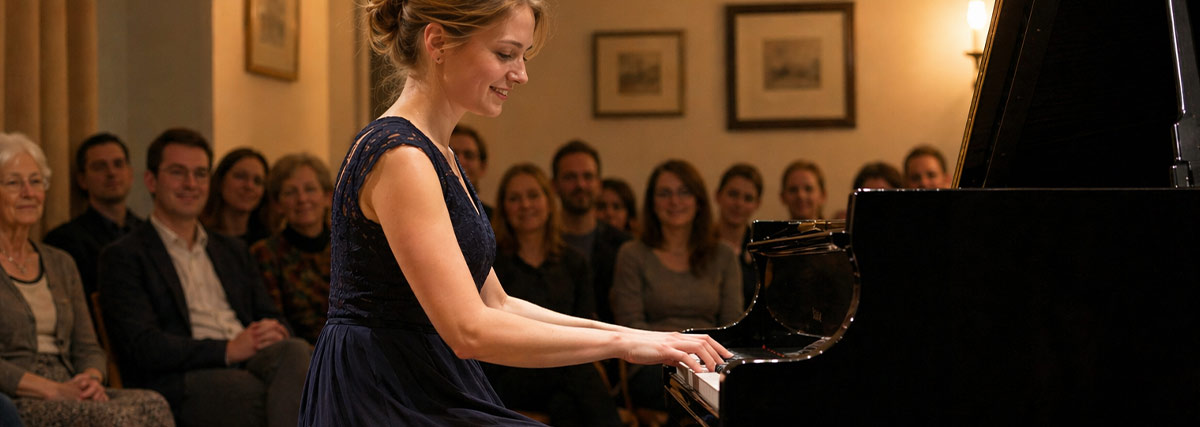
How Can Concerts Help to Accelerate Your Development?
Many adults feel apprehensive about performing in front of others.
That is completely normal.
Yet it is precisely this experience that is incredibly valuable.
Concerts give your practice a clear goal.
You know what you are working towards.
That naturally strengthens your discipline.
You also learn how to deal with nerves.
Mistakes do not become a problem, but part of the learning process.
You grow beyond your own expectations.
Every performance strengthens your self-confidence.
Suddenly, you begin to realise that you are capable of more than you thought.

The Courage to Be Seen
The first performance takes courage.
But it changes your perspective.
You experience music as a form of expression, not simply as practice.
Your focus begins to shift.
Away from perfection and towards communication.
To help you prepare well, the following steps can be useful:
- Practise your piece regularly under realistic conditions.
- Play in front of friends or family as a dress rehearsal.
- Breathe consciously to find a sense of calm.
- Accept small mistakes as part of the process.
- Celebrate your courage, not only the outcome.
This approach changes everything.
It takes the pressure off.
At the same time, it helps you feel more secure.
And that is exactly what makes you stronger.
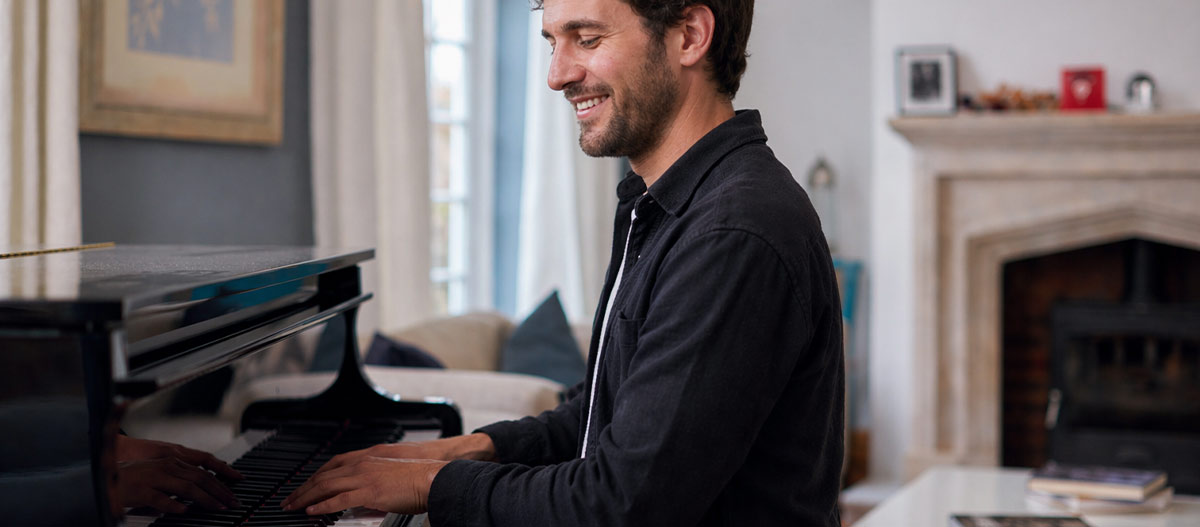
How Do You Stay Motivated in the Long Term?
Motivation does not arise through pressure.
It grows through positive experiences.
Small signs of progress play a major role.
They show you that your effort is worthwhile.
Variety is also essential.
Move between technique, pieces, and free playing.
This helps to keep your learning lively and engaging.
Set yourself achievable goals.
These give you a clear sense of direction.
At the same time, you should be careful not to overwhelm yourself.
A realistic plan is your best companion.
And it is exactly this that helps you maintain a lasting sense of joy throughout your musical journey.

Can You Still Learn a Musical Instrument at 60? Yes – and It’s Worth It
There is a persistent belief that it is best to learn a musical instrument when you are young. Children have plenty of time to practise, their brains are still developing, and it often seems [...]

Can Anyone Learn to Sing – or Do You Need a “Good Voice”?
When it comes to singing, the same belief comes up surprisingly often. Sooner or later, someone will say something like: “Unfortunately, I can’t sing.” Sometimes it is said quite matter-of-factly, sometimes with a little [...]

Returning to Piano After a Long Break: How Adults Can Start Again Successfully
At some point, the feeling returns. You hear a piece you once played, spot a piano at a friend’s house, or come across your old sheet music tucked away in a cupboard [...]

Singing Lessons in Berlin: Everything Beginners Should Know Before Their First Lesson
Starting singing lessons can be very exciting. At the same time, it is completely normal to feel a little nervous, especially when singing in front of a teacher for the first time. Many beginners… [...]

How to Find the Right Music Teacher in Berlin: 10 Things to Consider
Anyone who wants to learn music usually looks forward to the moment their lessons finally begin. However, before the first lesson takes place, there is one important question to consider: how do you find the right... [...]

The Second-Best Time Is Now: An Interview with Piano Teacher Wenxiao
“The best time to learn music may be in childhood — but the second-best time is always now.” An interview with our piano teacher Wenxiao about his journey into music, his mentors and [...]
SIMILAR ARTICLES