About the Author: Dolce Musik Institut Redaktion

When it comes to singing, the same belief comes up surprisingly often. Sooner or later, someone will say something like: “Unfortunately, I can’t sing.” Sometimes it is said quite matter-of-factly, sometimes with a little laugh – as though it had already been decided that their voice simply was not made for singing.
Often, there is a very specific experience behind this.
Perhaps someone was told at school as a child that they sang out of tune.
Perhaps they were once laughed at while singing with friends.
Or perhaps they compare themselves with a singer whose voice sounds effortless and perfect and think: I’ll never sound like that.
Over time, experiences like these can develop into a firmly held belief.
You begin to believe that singing is simply something some people can do – and others cannot.
But do you really need a special voice to learn to sing?
Not necessarily.

Your Voice Does Not Need to Be Perfect from the Start
No one expects a beginner pianist to be able to play a piece by Chopin in their very first lesson.
With singing, however, we often feel that you either “can” sing or you simply cannot.
Singing is a skill too.
You can learn to hit notes more accurately, use your breathing more effectively, control your voice and connect different parts of your vocal range.
Your musical ear can also be trained.
Of course, every voice is different.
Some people naturally have a wider vocal range, while others have a particularly powerful or distinctive voice.
That is wonderful, but it does not mean that someone with a less distinctive voice cannot learn to sing well.
Lessons are not about turning everyone into a particular type of singer.
It is about getting to know your own voice and discovering how to use it at its best.

“I Can’t Hit the Notes”
This is probably one of the most common concerns people have when considering singing lessons.
And sometimes that is indeed the case: the notes are not yet consistently in tune.
But that is very different from saying, “I can’t sing.”
Singing requires a precise connection between the ear and the voice.
You need to hear a note, imagine it in your mind and then reproduce it accurately with your own voice.
That may sound straightforward, but it is not necessarily so.
If this connection is not yet working well, it can be trained.
With simple exercises, you gradually learn to distinguish pitches more accurately and control your voice more precisely.
For some people, this happens very quickly; for others, it takes a little more time.
Both are completely normal.

What If I Don’t Like the Sound of My Own Voice?
This happens surprisingly often.
Your own voice can often sound unfamiliar on a recording.
When singing, this feeling can be even stronger.
On top of that, many people have a particular idea of what a “beautiful” voice should sound like.
But voices do not all need to sound the same.
A good voice is not necessarily a loud voice.
It does not need to be particularly high or particularly low, either.
And it certainly does not need to sound like the voice of a famous singer.
Some voices are warm and gentle, while others are direct and clear.
Some voices have a slight roughness, while others sound very bright.
It is precisely these differences that make voices interesting.
That is why singing lessons are not about trying to change your natural voice.
Instead, you learn how to work with it.

Do You Need to Be Musical?
Having a good ear is certainly helpful when singing.
But having a musical ear is not something that has to be fully developed from birth.
You can learn to recognise different pitches.
You can learn to recognise intervals by ear.
You can learn to sing a melody back more accurately.
It does not always happen overnight.
Sometimes, you only begin to notice your progress after a while.
Perhaps you suddenly find yourself singing a chorus without having to think about every single note.
Perhaps a difficult passage feels easier than it did just a few weeks ago.
Or perhaps you notice while singing that a note was too low and can correct it straight away.
These are important steps.

Learning to Sing Also Means Having the Courage to be Brave
Technique is only one part of singing.
Especially at the beginning, confidence plays an important role.
If you are constantly wondering whether your voice sounds “good enough”, you will often sing more tensely without even realising it.
That is understandable. After all, your voice is something very personal.
That is why singing lessons should provide a space where you feel free to experiment.
A wrong note is no big deal.
An exercise that does not work today may suddenly feel much easier next week.
And the more confident you become with your own voice, the easier it usually becomes to use it freely.
This does not apply only to people who hope to perform on stage one day.
Many people take singing lessons simply because they enjoy singing and want to get to know their voice better.

How Much Talent Do You Really Need?
Of course, some people find certain things easier from the very beginning.
Singing is no different from any other skill in that respect.
But talent is only part of the story.
Regular practice makes a big difference.
Just as important are good guidance and a willingness to give your voice time to develop.
And perhaps it is not even that important how quickly you make progress.
One person may want to feel confident singing in front of others one day.
Another may simply want to be able to sing their favourite songs better.
Someone else may want to use their voice professionally.
There is no single right reason to take singing lessons.

So, Can Anyone Learn to Sing?
Not everyone will have the same voice.
Not everyone will develop the same vocal range.
And not everyone will eventually perform professionally on stage.
But many people can learn to sing far better than they initially believe.
You do not need to start with a “good voice”.
What matters most is having a voice you can work with – and everyone has one.
If you have loved singing for a long time but have not yet felt confident enough to take singing lessons, you do not need to prove that you have talent first.
That is exactly what lessons are for.

Singing Lessons in Berlin and Munich
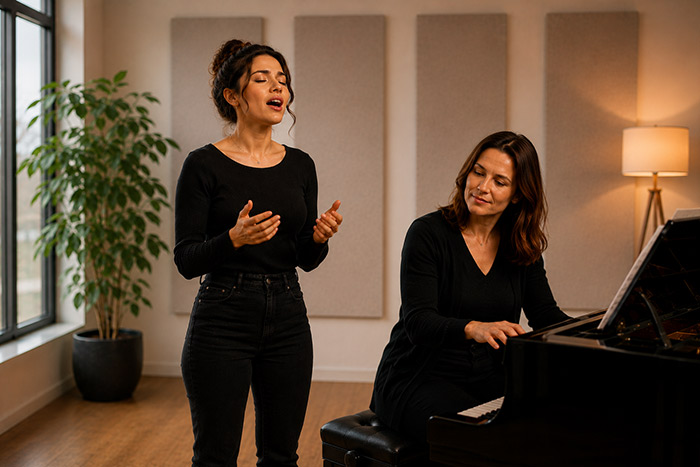
At Dolce Music Institute you can learn to sing from the very beginning or continue developing the skills you already have.
The lessons are suitable for different age groups and levels of experience – whether you are just starting out or would like to develop your voice in a more focused way.
Singing lessons are available in Berlin and Munich. möglich.
Perhaps your voice is not yet where you would like it to be.
That's not a reason not to start.
It might even be the best reason to start.

Which Instrument Should Adults Learn?
Many adults would like to learn a musical instrument. Getting started today is easier than it used to be. There are instruments that can be learned even without any prior musical knowledge. What matters most is choosing an instrument that suits one’s own personality. [...]

Is It Too Late to Learn a Musical Instrument as an Adult?
Many people dream of playing a musical instrument. However, many feel that they may have already missed the right moment to start. Adults in particular often doubt whether they can still learn successfully. This [...]

How to Keep Your Saxophone in Perfect Condition – Care and Maintenance
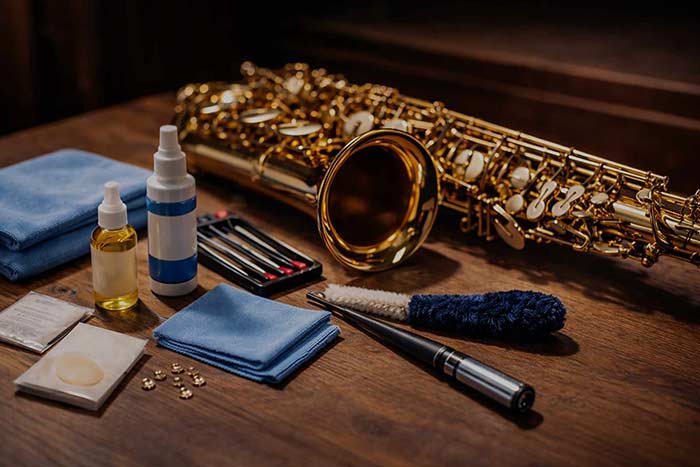
The saxophone is both a delicate and complex instrument. Proper saxophone care is essential to ensure that the instrument functions reliably over the long term and can produce its full, rich sound. To allow it to reach its full potential. [...]

The Dolce Music Institute: Germany’s Premier Destination for Adult Music Learners
Welcome to the Dolce Music Institute At the Dolce Music Institute, we believe in the transformative power of music and its unique potential to enrich the lives of adults. In [...]
SIMILAR ARTICLES