About the Author: Dolce Music Institute Editorial Team

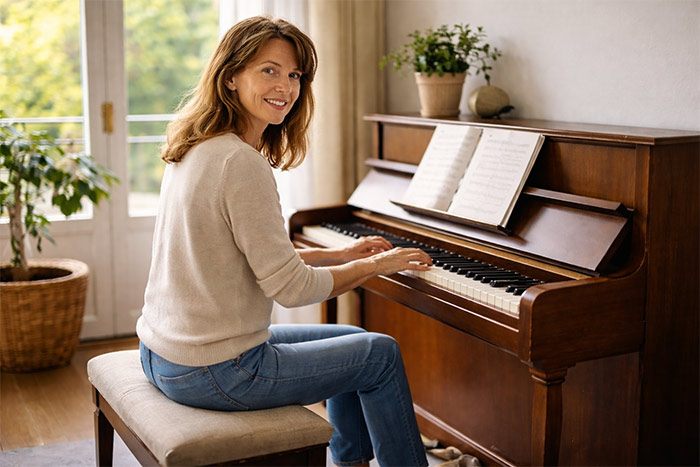
At some point, the feeling returns. You hear a piece you once played, spot a piano at a friend’s house, or come across your old sheet music tucked away in a cupboard. And suddenly you think: I’d really like to play the piano again.
Then the next thought often follows: But surely I’ve forgotten everything by now.
After five, ten or even twenty years away from the piano, it is completely normal for many things not to come as easily as they once did.
Your fingers may respond more slowly, reading music may take a little longer, and a piece you could once play with ease as a teenager can suddenly feel surprisingly challenging.
Even so, returning to the piano as an adult is often easier than you might initially think.
Because you are not really starting from scratch.
What Remains After a Long Break
If you used to play the piano regularly, you will already have developed a familiarity with many of the movements and musical patterns involved.
Even if they do not come back immediately, these skills can return surprisingly quickly once you start playing again.
You may notice this in something very simple: you sit down at the piano and play a familiar melody.
The first few bars may feel a little awkward. Then, suddenly, your hands seem to remember where to go.
Of course, not everything comes back all at once.
Technique, finger dexterity and confidence in sight-reading all take time to rebuild.
Coordinating both hands can also feel unfamiliar at first.
But that is precisely why returning to the piano is very different from starting again from the very beginning.
You are building on skills and knowledge you have already developed.
How quickly this happens depends on several factors, including how long you used to play, how long your break was, and how regularly you practise now.
Don’t Start with the Most Difficult Piece
This is where many returning pianists make the same mistake: they take out an old favourite and try to pick up exactly where they left off.
That is completely understandable, and sometimes it even works.
But more often than not, it simply leads to frustration.
If your fingers are not as confident as they once were, a difficult passage can quickly become a struggle.
You play it over and over again, make the same mistakes, and eventually start wondering why it used to feel so easy.
We would therefore recommend starting with pieces slightly below your previous level.
It may feel like a step backwards, but it isn’t.
A slightly easier piece gives your hands the chance to rebuild their familiarity and confidence.
At the same time, you will be rebuilding important foundations such as rhythm, articulation, dynamics and coordination between both hands.
And if a piece already feels very easy after a few days, that is a great sign. You can then move on to something slightly more challenging.
Short Practice Sessions Are More Than Enough
As a child, you may have been able to practise for an hour every day.
Adult life is usually very different.
Work, family and other commitments do not always leave much free time.
That does not have to be a reason to give up playing the piano.
When returning to the piano, regular, manageable practice sessions are often more effective than occasional long ones.
Three or four focused practice sessions each week can already make a significant difference.
Not every minute of practice needs to be technically demanding.
On one day, you might focus on scales and finger exercises.
On another day, you might work on a new piece. And sometimes, you may simply want to play for ten or fifteen minutes without focusing on anything in particular.
That counts too.
What matters most is making the piano a regular part of your daily life again.
What Should You Play After a Long Break?
The short answer: music you genuinely enjoy listening to.
That may sound obvious, but it is especially important for adult learners.
You do not have to start with a piece from a classical method book simply because you had classical lessons in the past.
Perhaps you would rather learn a film theme, play a pop song, or return to a piece you once loved.
A good piece for returning to the piano should not only be enjoyable to play, but also suit your current level.
This is where a piano teacher can be particularly helpful.
Together, you can choose a piece that genuinely interests you while still being technically manageable.
That is often a better approach than choosing a piece that looks appealing on paper but is still too difficult for your current level.
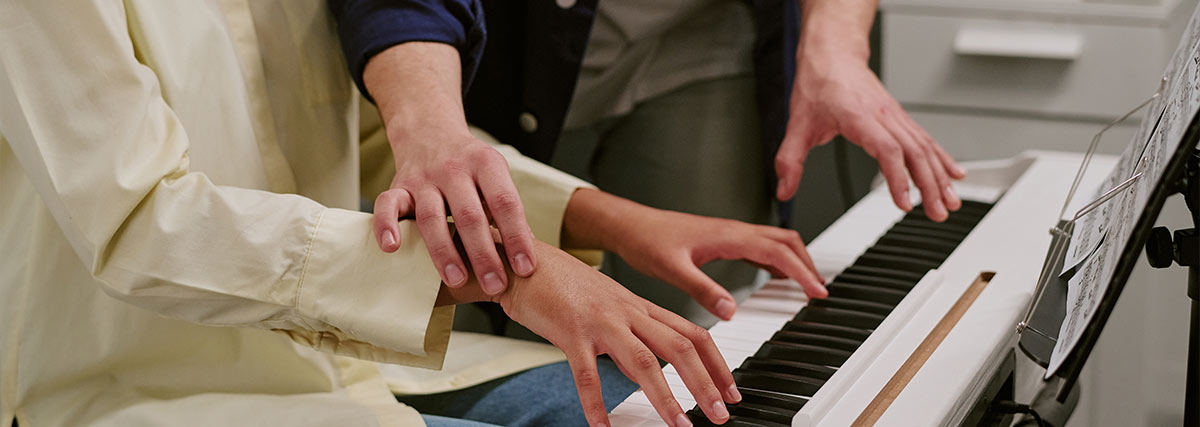
Is It Worth Taking Piano Lessons Again as an Adult?
Yes – especially after a long break, piano lessons can be extremely helpful.
It does not mean starting all over again with the basics, such as learning where middle C is.
A good teacher should first assess what you still remember, what comes naturally to you, and where any uncertainties have developed.
Perhaps you can still read music with ease but find finger technique more challenging.
Perhaps your technique is still surprisingly strong, while your rhythm and sight-reading have become a little rusty.
A teacher can quickly identify this during a lesson.
Another advantage is that you do not have to work out for yourself which exercises would be most useful at this stage.
A teacher can adjust the level of difficulty and help you avoid spending too long struggling with a passage that is simply too challenging at this stage.
Most importantly, you can tailor your lessons to your own goals.
After all, you are not a child practising for an exam.
Perhaps you simply want to feel confident playing the piano again.
Perhaps you would like to master a particular piece one day.
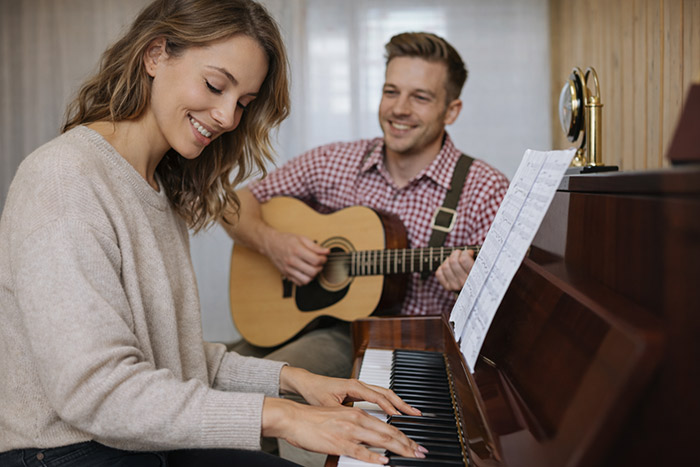
Or perhaps you would like to learn how to accompany yourself on the piano.
All of these are worthwhile goals.

Don’t Compare Yourself with the Pianist You Used to Be
This is probably the hardest lesson to learn when returning to the piano.
Perhaps you used to be able to play faster.
Perhaps you once learnt pieces that now feel very difficult.
Perhaps you were once a very accomplished pianist.
There is little to gain from constantly comparing yourself with how you used to play.
Your hands have not only forgotten the piano over the years.
They have also spent many years doing other things.
Your daily life is different now, your time is organised differently, and you probably approach learning differently too.
That is why the better question is not:
“Why can’t I play like I used to?”
But rather:
“What can I rebuild now?”
And this is exactly where adults have an advantage.
They usually have a much clearer sense of the music they enjoy and why they want to start playing again in the first place.

Progress Can Be Gradual
The first few weeks can feel a little unpredictable.
One day, a passage may go surprisingly well.
The next day, you may find yourself wondering why your left hand suddenly refuses to cooperate.
That is not a sign that your practice is not working.
When playing the piano, many movements only begin to feel natural again through repetition.
What requires conscious effort today may begin to feel automatic again after a few weeks.
That is why you should not judge your progress based on a single practice session.
Instead, look back after a few weeks.
Can you play a piece more confidently today than you could a month ago?
Are you reading music a little more quickly?
Does a particular chord progression feel easier to play?
When returning to the piano, these small improvements often say far more about your progress than any single good or bad practice day.
And What If You Can’t Practise Every Day?
Then you simply don’t practise every day.
That may sound too simple, but it is important.
Many adults set themselves goals when returning to the piano that are simply not realistic for their everyday lives.
Practising for an hour every day, learning several pieces at once, and working on theory and technique as well may be manageable for a couple of weeks.
After that, the piano often ends up sitting untouched again.
A realistic practice plan is usually more sustainable.
If you know you have time to practise three days a week, then plan around those three days.
And if you have a particularly busy week, it is perfectly fine to progress a little more slowly.
After all, playing the piano should not become just another obligation to tick off an already busy schedule.
The Best Part of Returning to the Piano
Perhaps that is exactly what changes the second time around.
As a child, you often learn the piano because your parents want you to, because lessons are simply part of your routine, or because you are expected to take an exam at some point.
As an adult, you sit down at the piano for a different reason.
You want to play a particular piece.
You miss the music. You want to unwind after a long day.
Or perhaps you simply wonder whether you can rediscover something that once brought you joy.
There is no wrong answer to that.
You do not need to reach the same level you were at twenty years ago.
You do not need to take an exam or perform in front of an audience.
Perhaps, to begin with, simply sitting at the piano for ten minutes is enough.
Then those ten minutes may gradually become twenty.
You add one piece to your repertoire, and perhaps another after that.
And at some point, you realise that you are no longer thinking about how long you were away from the piano.
You are simply playing again.
And that is when your real return to the piano begins.
Would you like to return to the piano after a long break? At Dolce Music Institute, we help adults rediscover the piano with personalised guidance and encouragement.
We look forward to supporting you on your musical journey back to the piano.

Can You Still Learn a Musical Instrument at 60? Yes – and It’s Worth It
There is a persistent belief that it is best to learn a musical instrument when you are young. Children have plenty of time to practise, their brains are still developing, and it often seems [...]

Can Anyone Learn to Sing – or Do You Need a “Good Voice”?
When it comes to singing, the same belief comes up surprisingly often. Sooner or later, someone will say something like: “Unfortunately, I can’t sing.” Sometimes it is said quite matter-of-factly, sometimes with a little [...]

Returning to Piano After a Long Break: How Adults Can Start Again Successfully
At some point, the feeling returns. You hear a piece you once played, spot a piano at a friend’s house, or come across your old sheet music tucked away in a cupboard [...]

Singing Lessons in Berlin: Everything Beginners Should Know Before Their First Lesson
Starting singing lessons can be very exciting. At the same time, it is completely normal to feel a little nervous, especially when singing in front of a teacher for the first time. Many beginners… [...]
How to Find the Right Music Teacher in Berlin: 10 Things to Consider
Anyone who wants to learn music usually looks forward to the moment their lessons finally begin. However, before the first lesson takes place, there is one important question to consider: how do you find the right... [...]

The Second-Best Time Is Now: An Interview with Piano Teacher Wenxiao
“The best time to learn music may be in childhood — but the second-best time is always now.” An interview with our piano teacher Wenxiao about his journey into music, his mentors and [...]
SIMILAR ARTICLES